How to Start a Home Care Business

A non-medical home care agency sends caregivers into seniors' homes to help with daily living: bathing, meals, errands and companionship. You don't need to be a nurse, but most states regulate these agencies, families or Medicaid pay by the hour, and the real work is finding clients and keeping reliable caregivers.

Built from 10 videos by 7 creators · Every figure links to the moment it was said · Last checked 2026-11-24

Startup cost
$700–10,000
Owners' own starts; franchises $40K–200K
Private pay rate
$30–35/hr
Up to $40–45 in pricier markets
Net margin
~30% vs 9–15%
Private pay vs Medicaid, one owner's agency
Caregiver wage
$15–17/hr
Two owners' examples, plus 15–20% payroll costs
Before income
3–6 months
One owner's advice; a licence took another 6 months
Pays for itself
~10 months
Our estimate with one part-time client
Startup cost each creator reportedMedian $2,500 · one dot per video
$0$3K$6K$9K$12K
Do this today · 30 minutes
Look up your state's home care licensing rules, then list 10 people you could talk to this week: a discharge planner at a nearby nursing facility, an elder care attorney, your church and your neighbours. Tell them you're planning a home care agency.

No money needed yet. The licence decides your timeline, so check it first. 01:3603:3204:1104:26

See the full plan

Watch the key moments

Each clip opens at the exact moment on YouTube.

The idea in brief

You get licensed where your state requires it, insure the business, then match trained caregivers with seniors who need help at home and bill by the hour. Families paying privately typically pay $30–35 an hour; Medicaid waiver programs pay less, and rates vary widely by state. As a senior care business you're essentially selling labour, so there's no inventory, but payroll goes out before clients pay. The owners' advice on how to start a home care agency comes down to three things: check your state's rules, keep enough cash for payroll, and build referral relationships before the licence arrives. 00:4501:3302:3020:4710:35

Is home care a good business for you?

Four quick questions about the day-to-day work the creators describe.

Can you answer the phone early, late and at weekends when a caregiver is running late or calls out?
Are you comfortable recruiting, onboarding and managing caregivers all the time?
Will you network with discharge planners, attorneys and families?
Can you cover payroll and bills for 3–6 months before income steadies?
Answer to see your fit

Is there demand for home care near you?

Real US Google searches, and an example of local competition. Data from DataForSEO, 2026-11-24.

“Home care near me”110,000US searches a month · keyword difficulty 28
“In home care near me”49,500US searches a month
What advertisers pay$12–17per click on those searches, a sign each client is worth a lot
People researching this business2,900searches a month for “home care business”
Real demand, but trust and staffing decide who winsFamilies search for home care constantly, and one owner values a single client at $10–15K. But competition is thick: owners say clients come from referrals, reviews and fast replies, and you need reliable caregivers ready before a client starts. 01:1111:4905:1210:37

Non-medical home care business startup cost and risk

If it doesn't work out

Lean monthly budget, one caregiver and one clientUnder $2,000/mo 19:10
Home care insurance, first year$5,000–10,000 14:14
Cash cushion owners advise6 months of expenses 08:38
A franchise instead$40K–200K + ~10% royalty 02:0302:41

There's little equipment to resell: most money goes on licensing, insurance and payroll. The bigger risks are time and cash flow: one owner's licence took 6 months, another says expect no clients in the first month, and payroll is due before clients pay. None of the 10 videos gave exit or resale figures, so we don't show a worst case. 02:4208:5310:35

When it pays for itself

~10months with one part-time client

Our estimate A $10,000 start ÷ about $900–1,000 profit a month from one 80-hour-a-month client (one owner's model at $30/hr billed and $15/hr paid) ≈ 10–11 months. With five part-time clients (about $4,000 a month profit in the same model) it would take under 3 months. 10:2012:2410:0520:26

Starting a home care business, step by step

The order the owners describe: rules and cash first, clients and caregivers lined up before the licence arrives. Tick steps as you go; progress saves on this device.

0 of 9 done
  1. Step 1Check your state's licensing rules before spending anything
    Some states license non-medical home care, some don't, and requirements for offices, nurses and caregiver checks differ. Your state health department sets the rules.01:3600:0417:5102:29
  2. Step 2Pick your path: franchise, consultant or do it yourself
    Franchises run $40K–200K plus royalties; consultants $5–15K; doing it yourself is cheapest but slower.07:2102:0306:30
  3. Step 3Save for payroll, not just the licence
    Aim for six months of expenses. Payroll is the biggest bill and goes out before clients pay.08:3810:3502:15
  4. Step 4Get insured early
    One owner needed a liability certificate of insurance to apply for the licence; another borrowed $700 for the deposit. Ask for pay-as-you-go workers' comp.12:5010:0710:46
  5. Step 5Set up lean
    Home office if your state allows, or an executive suite; a separate business phone; scheduling and visit-verification software; a payroll service.11:3107:2205:1312:5408:35
  6. Step 6Use the licence wait to build referrals
    One owner had her website and SEO running during a 6-month licence wait and networked because she had little money.02:4203:24
  7. Step 7Decide who pays: private pay first, Medicaid only if the rate covers your costs
    Work out your fully loaded cost per hour before you sign any payer contract.04:0109:1500:19
  8. Step 8Recruit caregivers continuously
    Track every candidate through interviews and checks, and tell everyone you're always hiring.12:3910:3705:05
  9. Step 9Bill weekly and set a minimum case size
    Invoice every Monday, pay caregivers every two weeks, and take cases of 20+ hours a week so caregivers get full schedules.10:2110:2903:08

Home care business plan (one page)

One owner suggests writing even a simple business plan, especially if family or friends are helping fund you. Here's one filled in with this guide's figures. Swap in your own. 07:49

ServicesCompanionship, personal care, homemaker and respite help; later a speciality such as dementia care 02:2106:36
Startup budget$700–10,000 from owners' own starts; a franchise is $40K–200K 10:0710:2002:03
Prices$30–35/hr private pay; Medicaid typically $23–30/hr 01:3302:30
Monthly costsCaregiver wages (~$15–17/hr) + 15–20% payroll taxes + 4–8% workers' comp; lean overhead about $2–3K/month 10:0508:1012:0311:3114:06
Break-evenAbout 10 months with one part-time client; under 3 months with five (our estimate)
MarketingDischarge planners, elder care attorneys, your own network, Google reviews, a referral bonus 03:3204:1105:0501:13
First goalFive part-time clients, about $4,000 a month profit in one owner's model 20:26

Home care license: check your state's rules first

Check your state's health department licensing rules before you spend money or take a client. Non-medical home care (help with daily living and companionship) is regulated differently in every state: some require a home care agency licence, some don't. Medical home health (nursing and therapy) is a separate, stricter category not covered here. Everything below is only what the owners said about their own states. It is not legal advice. 01:3600:0400:45

TopicWhat the owners saidSources
Licence or notRegulated states require a licence; owners say starting costs less in non-regulated states00:0401:36
How long it tookOne owner's licence took 6 months02:42
InsuranceOne owner needed a liability certificate of insurance to apply ($75–140/mo); workers' comp is required almost everywhere12:5013:2009:03
OfficeSome states require an office with proper zoning; others allow a home office02:2911:31
Nurse on staffSome states don't require one for a non-medical agency17:51
Caregiver checksTB tests, Live Scan fingerprinting and background checks depend on the state18:35
Visit recordsOne owner says visits must be electronically verified (EVV) and software is essential12:54
  • Rules change and differ by state. Confirm every requirement with your state health department (or the agency that licenses home care where you live) before you apply. 01:36

Private pay vs Medicaid waiver: who pays for home care

Most agencies mix payers. Private pay (families, sometimes long-term care insurance) pays more; Medicaid waiver programs pay less but can bring steady clients. Waivers pay for care at home instead of a nursing home, and rules and rates are set state by state. 01:3300:1903:14

What the owners saidSources
Private pay rate$30–35/hr typical; net margin around 30% in one agency01:3306:23
Medicaid rate$23–30/hr typical; one coach cites ~$11/hr in Louisiana and Texas; net margin 9–15%02:3001:0506:46
What waivers coverAging waivers (often 60+) pay for personal care, homemaker and respite services02:21
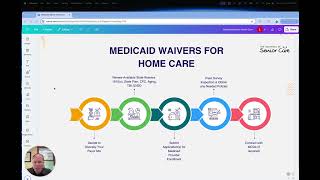
Becoming a waiver providerApply to the state Medicaid office; there may be a survey separate from your licence, then credentialing with each managed care plan04:4005:4306:0307:38
Hour capsSome programs cap hours per client per week05:11
  • Medicaid enrollment is described as the most complex of all payers. 05:00
  • Before signing, compare the rate with your fully loaded hourly cost. 09:1502:24

Home care franchise, consultant or do it yourself

Owners describe three ways in. None of the 10 videos covered buying an existing home care business for sale, so we don't cover that route here. 07:21

PathWhat the owners saidSources
Franchise$40K–200K to start, plus a royalty of about 10% of revenue for the life of the business02:0302:41
ConsultantTypically $5–15K; check that the price covers everything, not one piece at a time06:30
Do it yourselfCheapest on paper but slower; one owner started with $10,00007:2110:20
Private caregiver firstCare for one or two clients yourself, save, then grow into an agency05:47
  • Government grants for for-profit home care are uncommon; one owner points to SBA microloans instead. 08:3409:04

Home care marketing: where owners found clients

Your own circle

Tell family, friends, neighbours and church that you're accepting clients and always hiring

05:0504:26
Nursing facilities and discharge planners

Better for private pay than doctors' offices: they need somewhere safe to discharge patients

03:32
Elder care and estate attorneys

Their clients often have long-term care insurance and ask them who to call

04:11
Referral bonuses

One owner pays $200–1,000 to clients and caregivers who bring in a new client

00:3201:13
Website, SEO and Google reviews

One owner's first clients, including two 24/7 cases, came from search

01:4706:5105:12
Health fairs and senior expos

Meet families and other senior-care professionals face to face

03:05
Bought leads

About $66 each and shared with 4–5 agencies; one owner's batch of 20–30 converted slowly

16:3915:53

Home care rates: hourly bill rates vs caregiver wages

Home care is priced by the hour. Your margin is the bill rate minus the caregiver's wage and payroll costs. These are the figures the owners gave; rates vary a lot by state.

JobPriceSources
Private pay bill rate$30–35/hr; $40–45 in pricier markets01:3301:38
Example rate used by two owners$30/hr00:2610:05
Medicaid reimbursement, typical$23–30/hr02:30
Medicaid waiver, low-rate states one coach cited~$11/hr (Louisiana, Texas); ~$15 elsewhere01:0503:46
Caregiver wage examples$15/hr; $17/hr in New York (now higher)10:0508:10
Payroll taxes on top of wages15–20%12:0308:15
Workers' comp4–8% of payroll11:31
One 24/7 client at $30/hr$20,160 a month in revenue02:55
What one client is worth over time$10–15K, one owner's figure01:11

Three pricing rules from the owners

  • Know your fully loaded cost per hour (wage, payroll taxes, workers' comp, overhead) before you accept any rate 09:1508:15
  • Set a minimum of about 20 hours a week per client so caregivers get full-time schedules 03:0822:53
  • Don't undercharge: caregiving is hard work, and a rate near the wage leaves nothing for taxes or you 06:3502:24

A typical week running a small home care agency

Hours per client~45a week on average, one owner's agency 03:18
Minimum case20 hrsa week, so aides get full schedules 03:08
Team at first1–2people, often the owner and a spouse 02:4309:00
BillingWeeklyinvoice Mondays; pay caregivers every 2 weeks 10:2110:29

An owner's day, from the creators

  1. Start with the phone, voicemail, email and post 04:54
  2. If a caregiver is late or calls out, find cover or call the client straight away 06:27
  3. Touch the three engines every day: marketing, customer service and recruiting 10:37
  4. Return every enquiry within 24 hours, from families and job applicants 11:45
  5. Move each caregiver candidate along: interviews, state checks, drug screens 12:39
  6. Block time for follow-ups, and hold a weekly meeting even if it's just two of you 15:1009:00

Best time to start

US searches for “home care near me”, Nov 2025 – Oct 2026
JFMAMJJASOND
Families search for home care all year, with the biggest months from December to March. Because licensing can take months and owners say to expect 3–6 months before income, start the paperwork well before you plan to take clients. 02:4209:00

Creators agree

Creators disagree

Medicaid clients• Most of his clients are Medicaid; he'd rather the government pay than chase sick people for cash 07:09• At ~$11/hr you can't even hire a caregiver; focus on private pay 01:52
Office• Home office if your state allows it, or co-working 11:31• A $300/month executive suite gives you a proper address for listings and the bank 07:22
How to get started• Franchise or consultant for a faster, guided start 07:21• Work as a private caregiver first, then grow into an agency 05:47

Why people struggle

The mistakes the creators say they made, ranked by how many of them mention it.

Taking every case, whatever the hoursMentioned by 1 creators
Two-hour and four-hour cases are hard to staff because no caregiver wants to drive out for them.Avoid it: Set a minimum of about 20 hours a week.22:2503:08
Signing payer contracts below costMentioned by 2 creators
At an $11–15 Medicaid rate and a $10–13 wage, $1–3 an hour is left before employer taxes and overhead.Avoid it: Work out your fully loaded hourly cost first.09:1502:2403:46
Running out of payroll cashMentioned by 2 creators
Clients pay after the work; caregivers must be paid on time.Avoid it: Save months of expenses, invoice weekly, pay caregivers every two weeks.10:3508:3810:21
Overspending on tools too earlyMentioned by 1 creators
One owner calls it shiny object syndrome: new software subscriptions as soon as revenue arrives.Avoid it: Spend only on what brings a return.19:19
Slow repliesMentioned by 1 creators
Families and job applicants move on to the next agency.Avoid it: Call back within 24 hours.11:4511:49

How much do home care agency owners make?

No owner shared a real first-year profit. The rows below are two owners' models, built from their own rates and costs. Big-agency and best-case figures are listed separately.

First client1 owner's model
~$900–1,000/moProfit*
12:24
5 part-time clientssame owner
~$4,000/moProfit*
20:26
10 clients, 30 hrs/week1 owner (New York costs)
$45K–125K a year (≈ $3,750–10,400/mo)Profit*
21:2710:4010:24
$0$3K$6K$9K$12K/mo

* Models, not reported results. The low end is mostly Medicaid at ~$27/hr; the high end private pay at ~$32.50/hr. Scott McKenzie's spreadsheet puts 10 clients at $14–16K a month, higher than Karl Pierre's figures, which shows how much assumptions matter.

Standout examples, not typical results

Scott McKenzie's own agency peaked at about $53,000 a week in revenue, after starting in 2011. 22:4201:49
Karl Pierre describes himself as an 8-figure home care owner; he says 10 live-in private-pay clients could make $350–375K a year in profit. 05:4422:07
One 24/7 client at $30/hr is $20,160 a month in revenue, before wages (a nurse's napkin maths). 02:55
“Over five hundred thousand dollars a year” is possible with several clients, the same nurse says, with no guarantee. 00:0704:53
These are claims, not promisesWe report what creators say in their videos and can't verify it. Several sell courses, software or affiliate products, which we label in the sources. Some quote revenue (before costs), others profit; we say which. Your results depend on your area, prices, hours and effort.

Where it can go

  1. Stage 1 · StartPrivate caregiver or one clientSome owners began caring privately, then added family and friends as caregivers.05:4719:10
  2. Stage 2 · NextLicensed agency, 5–10 part-time clientsOutsource scheduling and the back office instead of hiring.20:2621:2716:17
  3. Stage 3 · ThenMore payersLong-term care insurance and Medicaid waivers, where the rate makes sense.04:0100:19
  4. Stage 4 · LaterLive-in and specialist care24/7 and dementia cases bring far more hours per client.22:0706:36

Case studies

Real operators from the source videos. Results are as they told them.

Risks to plan for

  • Low Medicaid rates: in some states the rate barely covers a caregiver's wage 01:52
  • Caregiver no-shows: you must find cover fast or the client goes without care 06:27
  • Months without income while you wait for the licence and first clients 08:5302:42
  • Payroll is due before clients pay 10:35
  • Some Medicaid programs cap weekly hours per client 05:11
  • Medicaid enrollment is complex: separate surveys and credentialing with each managed care plan 05:0005:4307:38
  • Bought leads are shared with 4–5 other agencies 16:39
  • Overstating your first-year size on insurance quotes raises the premium 12:30

All 10 source videos

Labels show whether each speaker runs the business and whether they sell something. Dates are approximate, from YouTube's “x years ago”.

Home Care Agency Business: Is a small agency profitable?Passive Workforce · Dec 2025
Agency owner (New York) and consultant
Sells consulting and its own scheduling software
How Much Does It Cost to Start a Non-Medical Homecare Agency? (Real Numbers)Sue Denis · Nov 2022
Nurse, agency owner and consultant
3+ years oldSells a done-for-you startup program
How Much Does It Cost to Start a Home Care Agency? (2026 Breakdown)RealScottMcKenzie · Mar 2026
Agency owner since 2011 and consultant
Sells $5K–10K setup packages; partner links (Paychex, Quo)
Home Care Series | Day in the Life of a Home Care Agency OwnerSimply Fujica · Nov 2023
Agency owner (California) and mentor
3+ years oldSells webinars and an academy
How To Grow Your Home Care Agency - 5 Strategies To Get Private Pay ClientsPassive Workforce · Nov 2023
Agency owner and consultant
3+ years oldSells marketing and consulting
How I Built A Successful Home Care Business In 6 MonthsI Am Coach Michele · Nov 2024
Agency owner turned coach
Sells coaching and conference tickets
Home Care Medicaid Waiver Reimbursement RateI Am Coach Michele · Nov 2022
Home care coach
3+ years oldSells coaching
You Can Make Over $500k Owning a Homecare Agency!Tricia Thomas, RN · Nov 2023
Nurse (napkin maths)
3+ years oldOffers paid help
Medicaid Waivers 101 - Home Care AgenciesThe Business of Senior Care · Nov 2025
Consultant
Sells Medicaid enrollment and billing help
Start Your Home Care Business With Limited Funds in 2025!I Am Coach Michele · Nov 2025
Agency owner turned coach
Sells coaching